Introduction
At-home beauty gadgets have become a fixture on bathroom counters, but many ask triple-digit prices to deliver just one technology. NuFACE leans on microcurrent, ZIIP blends microcurrent and nanocurrent, and FOREO Bear pairs microcurrent with pulsations—each usually $200 to $500.
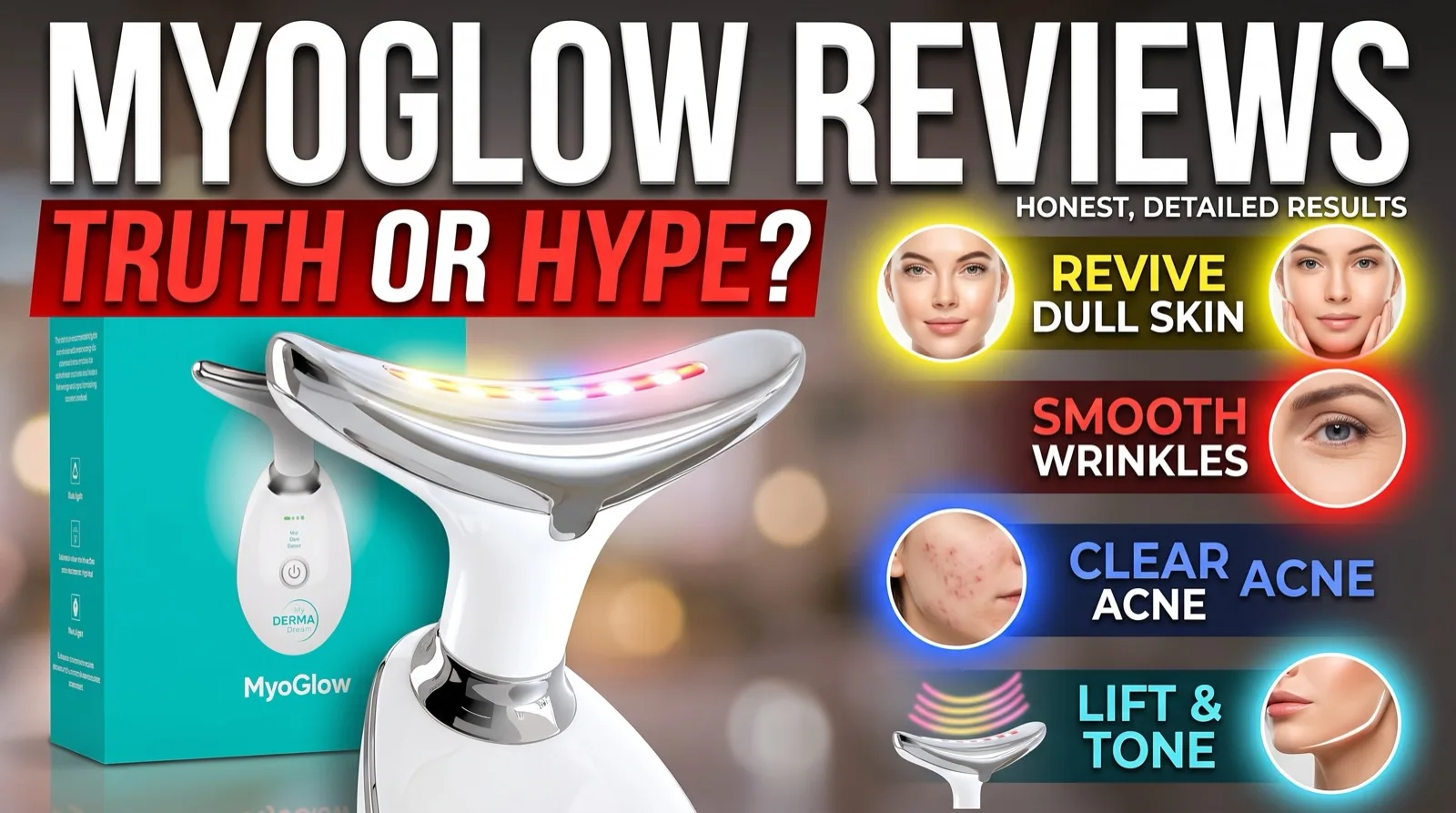
MyoGlow from My Derma Dream takes a different tack. It rolls four familiar skincare technologies—LED light therapy, electroporation, gentle heat, and sonic vibration—into a single handheld unit and includes three companion serums. The headline: promotional pricing of $119.
Over six weeks, the device was used across face, jawline, and neck, with progress tracked in weekly photos and notes on texture, firmness, and puffiness. The experience was measured against the marketing promises and the published literature behind each tech.
Below, you’ll find a clear-eyed look at what MyoGlow can and cannot do, how the science lines up, where expectations need a reality check, and whether the bundled technologies warrant the spend. You’ll also see how it compares with better-known microcurrent devices featured in broader at-home tightening roundups, plus whether the included serums feel purposeful or just padding.
TL;DR / Verdict
- Does it work? Yes—provided you’re consistent. Each tech is research-backed; combined effects show up gradually.
- How fast? Texture tends to improve within 2–3 weeks; skin looks a bit firmer by weeks 4–6 with daily use.
- Comfort? Easy and pleasant. The warmth is soothing, and the vibration feels relaxing.
- The catch? No dramatic overnight lifting. Expect slow, steady changes and commit to daily sessions.
- Who it’s for? Anyone wanting multiple technologies in one device without paying $300–$500 for a single-feature tool.
- Who should skip it? Shoppers seeking instant transformation or those unlikely to use it every day.
- Rating: 7.8/10
- Best deal: 60% off the Trio bundle during the current promo
What Is MyoGlow?
MyoGlow is a compact, handheld skincare device from My Derma Dream that merges four modalities: multi-wavelength LED light (red, blue, and green/amber), electroporation to enhance topical penetration, thermal therapy for circulation and puffiness, and sonic massage for tension relief and contouring.
The Trio bundle includes the device, three serums (NoTox Peptide Serum, Niacinamide 5% Activator Serum, and Glide & Glow Ultra-Creamy Plumping Serum), a USB charging cable, and an instruction booklet. It’s currently advertised at $119 (regular $299).
The idea is to replace buying a dedicated LED panel, a microcurrent massager, and a separate tool for product infusion by offering several approaches within one routine. The marketing focuses on visible firming and contouring of the face, jawline, and neck in 5–10 minutes per day.
The standout here is electroporation. Many affordable devices omit this feature, yet it’s the mechanism that helps actives move beyond the skin’s outer barrier rather than sitting on top.
My Derma Dream cites over 200,000 customers. On its own site, MyoGlow averages 4.9/5 across 220 reviews, though brand-hosted ratings tend to skew positive. Independent sources are more mixed but generally favorable, praising the value while reminding buyers that patience is required.
Positioned as accessible “spa-adjacent” tech, the brand supplements the hardware with education—free Masterclasses and a skincare app—so users have guidance past the quick-start leaflet.
How MyoGlow Works: The Four Technologies
Understanding each component makes it easier to judge the overall package.
LED Light Therapy
LED exposes skin to specific wavelengths that influence cellular activity. This is one of the better-researched at-home approaches.
- Red (640–670nm): The anti-aging workhorse studied for collagen and elastin support. Research has linked consistent red LED use with improved texture, fine lines, and firmness; a 2014 paper in Photomedicine and Laser Surgery showed texture and wrinkle gains over 12 weeks.
- Blue (440–470nm): Targets acne-related bacteria and can help regulate oil—useful if you breakout occasionally.
- Green/Amber (565–570nm): Commonly associated with calming puffiness and supporting tone evenness. Evidence is lighter than for red, but the rationale is plausible.
Electroporation
Brief electrical pulses temporarily increase the permeability of cell membranes, opening microscopic channels that let active ingredients travel deeper. A study in the International Journal of Pharmaceutics reported up to a 1000-fold boost in skin permeability for certain molecules. In practical terms, peptides from NoTox and niacinamide from the Activator Serum get a better shot at the layers where they can actually do something.
Thermal Therapy
Mild heat helps with circulation, reduces morning puffiness, and preps skin so topicals absorb more readily. The sensation is comparable to a warm towel on the face—pleasant and nowhere near hot enough to harm tissue. The warming step also complements the other modes.
Sonic Massage
Vibrations help scatter serum evenly and relax tight facial muscles. With routine use, massage can soften expression-related lines and enhance a lifted, less puffy look. Think of it like an automated, gentle gua sha that also makes the process feel spa-like.
The Claim vs. The Fine Print
“Visibly lifted, firmer-looking skin”
Possible with steady use, but expect a longer runway than the ads imply. Measurable changes in texture can show up within weeks; a true “lifted” look takes time—often months.
“Professional-grade results at home”
The same categories of tech are used in clinics, but consumer devices have lower intensity and smaller coverage. Results are real, yet typically subtler than what an esthetician can deliver with clinical hardware.
“No appointments, no needles, no downtime”
Accurate. There’s no pain and no recovery period.
“Just 5–10 minutes daily”
The treatment window is on point. Add a couple of minutes for serum application and cleanup, and you’re at roughly 10–15 minutes total.
Bottom line: the tech is legitimate and thoughtfully combined for the price. The messaging overreaches on speed and drama—set your expectations to “gradual improvement.”
Design and Build Quality
The device is slim, lightweight, and comfortable to hold. The curved treatment head tracks easily over cheeks, jawline, and neck without arm fatigue. Buttons have a reassuring click, mode indicators are easy to read, and it charges via standard USB—no oddball cables.
Casing and fit feel solid for the price, though it lacks the heft of premium $400 devices. The treatment head is smaller than pro LED panels, so you cover the face in passes rather than all at once.
The included serums use simple pump packaging. Textures differ: NoTox is more viscous, Niacinamide is light and quick to sink in, and Glide & Glow is the creamiest. They’re perfectly fine starters, especially for electroporation, though serum aficionados may eventually swap in favorites.
How to Use MyoGlow: Step by Step
- Cleanse: Start with a thoroughly cleansed face so makeup and sunscreen don’t block light or interfere with absorption.
- Apply serum: Pick one—NoTox (firming/anti-aging), Niacinamide 5% (clarity/oil), or Glide & Glow (hydration/plumping)—and apply a generous layer.
- Choose your mode: Power on and select a setting. Begin at the lowest intensity and increase as your skin adapts.
- Glide in sections: Use slow, upward strokes over cheeks, jawline, and neck, spending about 2–3 minutes per area.
- Seal it in: Finish with your usual moisturizer. If it’s daytime, add sunscreen.
Testing Methodology
The device was used once nightly for six weeks. Each included serum was featured for roughly two weeks to see how pairing it with MyoGlow felt. Weekly photos under similar lighting helped track changes in texture, firmness, puffiness, and overall glow. Practicalities—battery life, comfort, and routine fit—were noted.
Skin context: 30s, combination skin, early fine lines around the eyes, some jawline puffiness. Prior experience included a basic LED mask but not a multi-tech tool.
Use mirrored everyday conditions: a few rushed nights, a couple of too-thin serum applications, and one travel week. The compact body and USB charging made it easy to pack, highlighting a portability advantage over bulkier systems.
Real-World Performance: Week by Week
Weeks 1-2: Getting Started
The first days were about learning the right pressure and pace. The warmth was instantly pleasant; vibration made the routine feel like wind-down time. Post-session skin felt smooth to the touch—likely from better serum spread and absorption. By the end of week two, there was a slight uptick in radiance. NoTox felt the most substantial on skin.
Weeks 3-4: Noticing Changes
Around week three, the jawline looked a touch more defined in photos, and morning puffiness was toned down. Texture felt smoother, and makeup glided on more evenly. Comparing week-one to week-four photos revealed a more even tone and a subtle softening of nasolabial folds.
Weeks 5-6: Consolidation
Improvements held and built in places: a firmer feel along the jaw, consistently smoother texture, and a generally more rested look. Nothing extreme, but clearly better. An unexpected bonus was how regular skincare seemed to perform more effectively after sessions—consistent with electroporation improving absorption.
MyoGlow vs. Competitors: How It Stacks Up
Against the category leaders, MyoGlow’s value is its breadth at a low price:
- MyoGlow ($119): LED + electroporation + thermal + sonic. Three included serums. No app required. 5–10 minutes. FDA status not specified. Independent studies exist for the individual technologies, not the exact device.
- NuFACE Trinity+ ($299): Microcurrent only (LED add-on costs extra). Optional app. 15–20 minutes. FDA cleared. Strongest published, device-specific microcurrent data.
- ZIIP HALO ($495): Microcurrent + nanocurrent. App required for 20+ protocols. 10–15 minutes. Moderate published support. Premium pricing.
- FOREO Bear Pro ($399): T‑Sonic + microcurrent. App-guided. 5–10 minutes. FDA cleared. Limited independent data.
Takeaway: If you prize breadth and price, MyoGlow is compelling. If you want device-specific clinical evidence and FDA clearance, NuFACE and some premium rivals have the edge.
The Serums: What’s Actually Inside
All three are designed to pair well with electroporation so active ingredients can get more mileage.
NoTox Peptide Serum
Peptides signal the skin to step up collagen production. This formula aims at firmness and fine lines. In pairing with the device, it provided the most noticeable texture refinement among the trio.
Niacinamide 5% Activator Serum
Niacinamide (vitamin B3) at 5% supports clearer-looking skin, helps balance oil, and can make pores appear smaller. Light texture makes it a good daytime pick.
Glide & Glow Ultra-Creamy Plumping Serum
Focused on hydration with hyaluronic acid and moisturizers for a temporarily plumper look. The creamy feel suits dry or dehydrated skin and leaves a soft, bouncy finish for hours.
They’re solid companions to start with. If you already have go-to serums, you can use them with MyoGlow as well.
Tips to Get the Best Results
- Consistency beats intensity: 5 minutes daily outperforms sporadic, longer sessions.
- Begin on clean skin so LED and electroporation aren’t blocked.
- Use enough serum to maintain slip and conductivity—especially over lines and uneven texture.
- Glide upward and outward to support a lifted look.
- Give it 8–12 weeks before judging final outcomes.
- Charge every few days; expect about 4–5 sessions per charge.
- Spend extra time on your top concerns (jawline, under-eye puffiness, forehead lines).
- Wipe the treatment head after each use to prevent build-up.
- Wear SPF 30+ daily, especially if you do evening LED sessions.
Troubleshooting Common Issues
Feels weak or inconsistent: Clean the head and ensure full skin contact. Buildup can dampen performance.
No changes after 4 weeks: Some improvements emerge later. Texture often shifts by weeks 3–4, while firmness may take 8–12 weeks. If nothing changes by week 8 despite daily use, it may not suit your skin.
Skin feels dry post-session: Lock in hydration with moisturizer. Glide & Glow helps counter transient moisture loss.
Redness or irritation: Temporary flushing can happen. If it persists past 30 minutes or stings, shorten sessions or reduce frequency; discontinue and consult a dermatologist if it continues.
Battery dies mid-use: Charge every 3–4 days. Keep the USB cable handy to avoid derailing your routine.
Serum sinks in too fast: Apply a thicker layer or lightly mist your face with water first to slow absorption and improve slip.
Comparison to Professional Treatments
Pro LED panels: Deliver higher light intensity and full-face coverage, but run $100–$300 per session. MyoGlow is less intense yet unlimited-use at home.
Med spa microcurrent facials: Often yield immediate, short-lived lifting (3–7 days) for $200–$400 a visit. MyoGlow builds subtler changes over weeks with no downtime.
At-home microcurrent (NuFACE, ZIIP): Closer competitors. MyoGlow trades microcurrent for a mix of LED, electroporation, heat, and sonic.
Chemical peels: Provide fast resurfacing with downtime and higher costs. MyoGlow is gentler and addresses puffiness/contour—different toolkit, different results.
In short, MyoGlow sits between simple at-home tools and clinical treatments—wider coverage than most home devices, less intensity than pro visits.
Who Should Skip MyoGlow
- If you’re chasing instant, dramatic change for an event in a few weeks.
- If you have active, severe acne; the heat and vibration may aggravate inflammation.
- If you have rosacea or very reactive skin; the warmth and massage can trigger flushing.
- If you expect the serums alone to deliver dramatic results.
- If daily use isn’t realistic for you.
Who Should Buy MyoGlow
Buy it if:
- You want multiple technologies without paying premium-device prices.
- You’ll commit to daily sessions for at least 8 weeks.
- You like tackling firmness, texture, puffiness, and absorption in a single routine.
- You want included serums so you can start right away.
- Value per dollar matters.
Skip it if:
- You expect obvious changes within days.
- Consistency isn’t your strong suit.
- You require FDA clearance.
- You already own a top-tier microcurrent device and are satisfied.
- You have conditions that require dermatology guidance before using LED or heat.
Side Effects and Safety
Designed for all skin types, including sensitive and mature skin, the device uses gentle heat and non-invasive light. Most users won’t encounter issues, but keep a few cautions in mind:
- Photosensitivity: If you take meds that increase light sensitivity (certain antibiotics, retinoids, or Accutane), consult a dermatologist before LED use.
- Pregnancy: The brand doesn’t specify use in pregnancy or nursing; ask your doctor first.
- Reactive skin: If you have rosacea, eczema, or active breakouts, test LED alone and introduce heat/vibration cautiously.
- Electroporation: Those with a pacemaker or implanted electrical device should avoid electroporation and stick to LED/sonic modes only.
Pricing, Discounts, and Value
The Trio bundle lists at $119 (regularly $299). That 60% promo is offered frequently, so don’t feel rushed by timers.
For $119, the deal is strong: four technologies plus three serums for less than many single-tech devices. For comparison, NuFACE Mini+ is $179 (no LED or heat), and FOREO Bear starts at $199 (no electroporation).
The 90-Day Glow Guarantee lets you try it for roughly three months and exchange if it’s not a fit—enough time to judge gradual progress. Orders over $100 ship free, typically arriving in 3–5 business days.
Value verdict: even if results land in the “modest but noticeable” zone, the per-technology cost is tough to beat—and the bundled serums add meaningful starter value.
Deep Dive: The Science Behind Each Technology
LED Light Therapy Research
Red light in the 630–670nm range has the strongest backing. A 2014 randomized trial in Photomedicine and Laser Surgery (633nm) showed improved texture and fewer wrinkles after 12 weeks. A 2017 review in Seminars in Cutaneous Medicine and Surgery concluded LED phototherapy is safe and can significantly improve tone, texture, and fine lines.
Blue light (440–470nm) targets acne bacteria closer to the surface, and green/amber (565–570nm) has lighter evidence but plausible roles in reducing puffiness and calming tone. Handhelds have lower irradiance than clinic panels, so sessions need to be longer and more targeted.
Electroporation: The Absorption Advantage
As summarized in Journal of Controlled Release, electroporation creates temporary microchannels in cell membranes, which lets larger or less permeable molecules traverse the skin barrier. For skincare, that means more actives reach viable layers instead of evaporating or sitting on the stratum corneum. Gains vary by molecule and formula but are directionally meaningful.
Thermal Therapy: More Than Just Warmth
Research in Journal of Cosmetic and Laser Therapy shows warming skin to roughly 40–42°C can increase blood flow by 30–50%, improving delivery of oxygen and nutrients. Heat also helps ingredients move more efficiently and relaxes contracted facial muscles. Better lymphatic flow explains some of the de-puffing users report.
Sonic Massage: The Contouring Component
Vibration in the 8,000–12,000 RPM range offers mechanical stimulation that supports lymphatic drainage and may help release fascial tension. A study in Journal of Clinical and Diagnostic Research linked facial vibration massage with reduced cortisol and better skin appearance over eight weeks—aligning with the relaxed, less puffy look users notice over time.
MyoGlow vs. NuFACE: The Head-to-Head
Technology: NuFACE is all about microcurrent muscle stimulation. MyoGlow swaps microcurrent for LED, electroporation, heat, and sonic vibration—different paths to similar goals.
Evidence: NuFACE invests in device-specific studies and is FDA cleared. MyoGlow leans on research for each individual technology rather than combined-device trials.
Experience: NuFACE requires conductive gel and 15–20 minutes. MyoGlow uses serums you’d apply anyway and takes 5–10 minutes; the warming step adds a spa feel.
Results: NuFACE users often call out more obvious short-term “lift.” MyoGlow users typically report smoother texture, less puffiness, and brighter tone over time.
Price: NuFACE Mini+ is $179, Trinity is $299, and Trinity+ with attachments goes higher. MyoGlow is $119 with three serums.
Verdict: Choose NuFACE if microcurrent with published, device-level data is your priority. Choose MyoGlow for broader modalities at a lower cost.
MyoGlow vs. ZIIP HALO: Premium vs. Value
ZIIP HALO costs $495 and layers microcurrent with nanocurrent, controlled by an app offering 20+ guided routines. Nanocurrent’s ultra-low-intensity signals may nudge cellular processes differently from microcurrent. MyoGlow has no nanocurrent equivalent and no app—simpler, cheaper, and more generalist.
ZIIP suits tech-forward users who want maximum customization and are comfortable with premium pricing. MyoGlow caters to those exploring multiple technologies without the steep buy-in.
MyoGlow vs. FOREO Bear: The Lifestyle Pick
FOREO Bear Pro ($399) pairs T‑Sonic pulsations with microcurrent and includes an Anti‑Shock System to modulate current. It’s beautifully designed and app-guided. MyoGlow looks more utilitarian but packs different tech (LED and electroporation notably). Ease of use is strong for both; Bear’s app hand-holds beginners, while MyoGlow’s phone-free operation keeps things simple.
Brand Reputation and Customer Support
My Derma Dream reports 200,000+ customers and supports buyers with bi-weekly consultations, a free Masterclass program, and a Habit Tracker App. Feedback suggests responsive support. The 90-Day Glow Guarantee outlasts many competitors (NuFACE 60 days, ZIIP 30 days). The brand is independent and not connected to NuFACE.
Long-Term Value and Cost Per Use
At $119 and an estimated 2–3 years of regular use, daily treatments land around $0.16 per session. The included serums add roughly $60–$80 of value. Two med-spa facials could match the device’s entire cost, whereas MyoGlow can be used indefinitely at home.
Replacement serums run $20–$80 and typically last 4–6 weeks with daily use, though you can substitute any compatible favorites to suit your skin and budget.
The Bottom Line: Is MyoGlow Worth It?
MyoGlow doesn’t promise miracles—and that’s good. It assembles four well-known technologies into a user-friendly device, includes starter serums, and keeps the price accessible. LED has strong support, electroporation meaningfully improves serum uptake, and the warmth and vibration make the routine easy to stick with.
Expect measured progress: smoother texture, reduced puffiness, and a healthier look over weeks—not a jaw-dropping lift in days. At $119 with a 90-day trial window and three serums in the box, the risk-to-reward balance is solid for anyone curious about multi-tech skincare.
Final Verdict
Score: 7.8/10. MyoGlow’s strength is value: four genuine technologies, comfortable daily use, and included serums at a price far below premium rivals. Weaknesses are the lack of device-specific clinical trials and marketing that implies faster results than most users will see.
If you want an all-rounder without splurging, it deserves a spot on your shortlist—as long as you bring patience and consistency.
Key Specifications
- Device type: 4‑in‑1 (LED + electroporation + thermal + sonic)
- LED wavelengths: Red (640–670nm), Blue (440–470nm), Green/Amber (565–570nm)
- Treatment time: 5–10 minutes per session
- Power: USB‑rechargeable battery
- Form factor: Lightweight, handheld design
- Included serums: NoTox Peptide, Niacinamide 5%, Glide & Glow Plumping
- Guarantee: 90‑Day Glow Guarantee
- Shipping: Free on orders over $100
Verdict snapshot: 7.8/10. Very good—recommended with minor caveats. Notable highs: four technologies in one, solid starter serums, and easy daily use. Main trade-off: changes arrive gradually, not overnight.
Common Questions & Answers
Q: Does MyoGlow actually work for skin lifting?
MyoGlow combines LED, electroporation, thermal therapy, and sonic massage—each supported by published research for skin improvement. Over several weeks, many users notice smoother texture and less puffiness, particularly around the jawline. Results build slowly; “lifting” in the strict sense generally takes consistent use over time.
Q: How long does it take to see results with MyoGlow?
Early changes, such as softer texture and a bit more glow, often show in 2–3 weeks. Firmer-looking skin and contour refinements tend to appear around 6–8 weeks with daily sessions. Skipping days can slow progress.
Q: Is MyoGlow safe for sensitive skin?
It’s designed for all skin types, including sensitive and mature. The wavelengths and heat level are gentle. As with any new tool, patch test and check with a dermatologist if you have known sensitivities or conditions.
Q: What serums come with MyoGlow?
The Trio bundle includes NoTox Peptide Serum (firming/anti-aging), Niacinamide 5% Activator Serum (clarity/oil control), and Glide & Glow Ultra‑Creamy Plumping Serum (hydration). They’re formulated to pair with electroporation for enhanced absorption.
Q: How is MyoGlow different from NuFACE or ZIIP?
NuFACE and ZIIP focus on microcurrent (ZIIP also adds nanocurrent). MyoGlow centers on LED, electroporation, heat, and sonic massage. It’s also priced much lower at $119 with three serums included, but lacks the device-specific clinical data and FDA clearance found with some premium microcurrent tools.
Q: Can I use MyoGlow with retinol or vitamin C serums?
Yes, though ease into it. Retinol can increase sensitivity, so start with shorter sessions. Vitamin C pairs well with electroporation and may penetrate more effectively. Avoid stacking retinol and a full device session the same night if you’re prone to irritation.
Q: How do I clean and maintain the device?
Wipe the treatment head with a soft, damp cloth after each use; use mild soap weekly if needed. Don’t submerge the device. Keep the head free of residue so LEDs shine through unobstructed.
Q: How does MyoGlow compare to DIY LED masks from Amazon?
Low-cost masks often use inconsistent wavelengths and lack quality control. MyoGlow targets specific therapeutic ranges and adds electroporation, heat, and sonic modes—capabilities most budget masks don’t include—plus a sturdier build.
Q: Can men use MyoGlow?
Absolutely. The tech and serums are not gender-specific. Thicker skin may benefit from slightly longer passes. If you have facial hair, clean the device head more frequently.
Q: Where can I buy MyoGlow and is there a guarantee?
MyoGlow is sold via the official My Derma Dream website. The Trio bundle is currently $119 (down from $299) and covered by a 90‑Day Glow Guarantee for exchanges. Buying direct helps ensure authenticity and full policy coverage.
More Wellness Gadgets Reviews
- Nooro Knee Massager Review 2026: 21 Nights of Testing Nov 4, 2026 7.2
- Qinux FootRevita Review 2026: 4 Weeks of Real Foot Testing Nov 4, 2026 6.8
- Rangii Review 2026: 21 Nights of Nail Fungus Testing Nov 4, 2026 7.2
Related Guides & Articles
- Best Sleep Masks 2026: 5 Tested and Ranked
- Best Sleep Masks for Side Sleepers 2026: 5 Tested
- Sleep Ease vs Dodow: Two Drug-Free Ways to Fall Asleep Faster